At 7:30 in the morning, a phlebotomist arrives at a patient's home.
The patient has been fasting since the previous night. A few minutes later, the blood has been collected, the tubes are labelled and the collection is complete.
For the patient, the appointment is over.
For the blood sample, the journey has only just begun.
That small tube now has to travel from the home to the laboratory where it will be received, checked, prepared and tested.
And this part of the process is rarely visible to the patient.
What happens to the sample after it leaves the doorstep? How is it protected? Does it always need refrigeration? What happens if transportation is delayed? And why does medical logistics matter to something as simple as a blood test?
Let's follow the sample from home collection to laboratory testing.
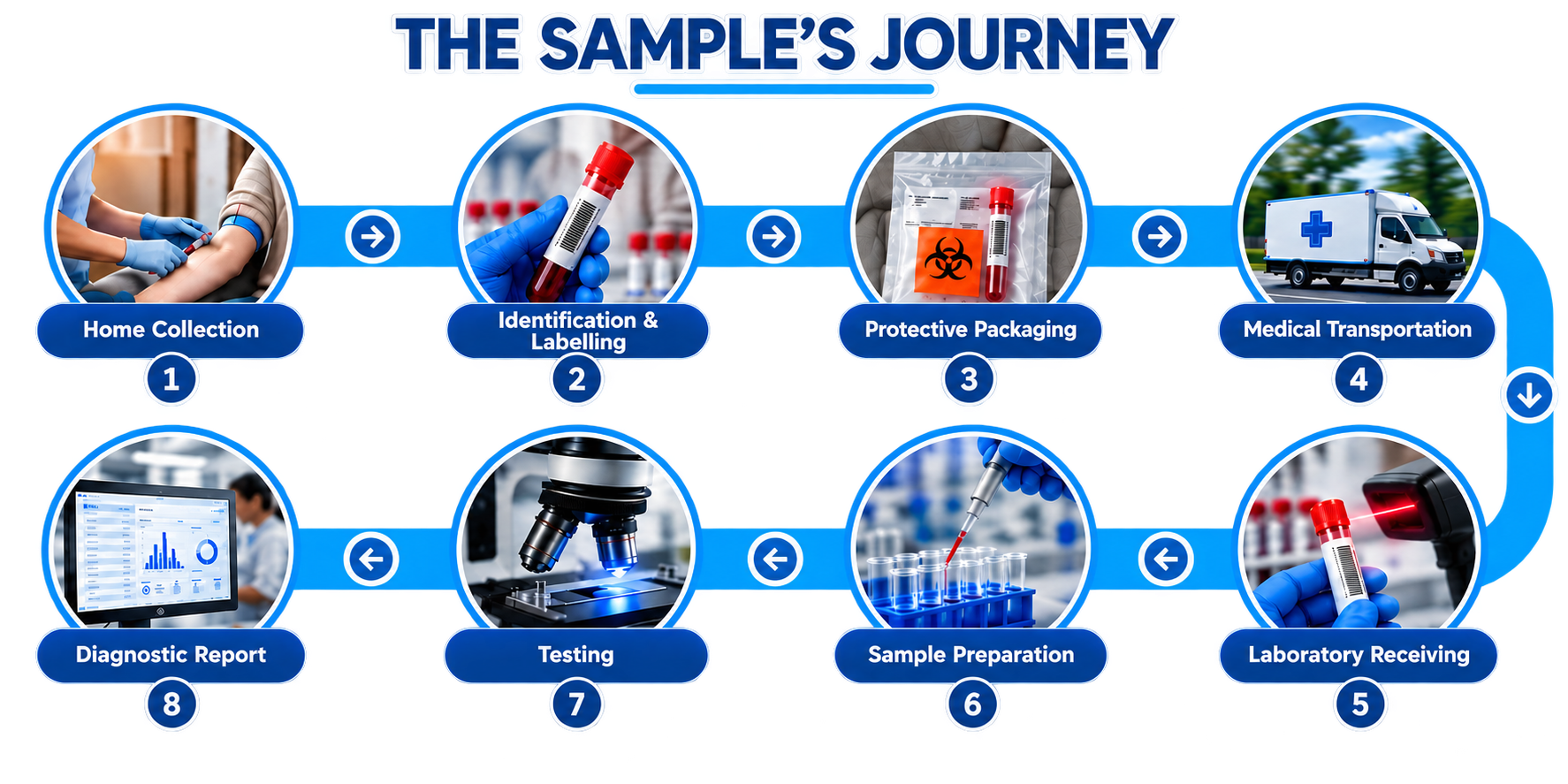
The Blood Tube Has Left the Patient's Home. What Happens First?
Imagine the sample as a traveller.
Before it starts its journey, it needs the correct identity and the right conditions for travel.
The healthcare professional who collects the blood doesn't simply put the tube into a bag and leave.
The sample needs to be identified according to the laboratory's procedures, associated with the correct test request and prepared for transportation.
This first handover is important because the laboratory needs to know whose sample it is, what testing is required and how the specimen should be handled.
A mistake at this stage can create problems much later in the process.
Advice for patients
Before the collection professional leaves, it is reasonable to confirm:
- Has the sample been properly labelled?
- Has the requested test information been recorded?
- Do I know where the sample is being sent?
- When should I expect the report?
You don't need to inspect the tube yourself. The important thing is that the collection is being performed through an organised diagnostic process.
Step 1 — Identification Comes Before Transportation
A blood sample may look like an ordinary tube, but inside it is information that will eventually become part of a patient's medical report.
That makes identification critical.
The tube must remain traceable to the correct patient and requested investigation throughout its journey.
The exact information recorded varies between laboratories and testing systems, but sample identification and patient matching are fundamental parts of laboratory specimen management.
Why this step matters
Consider two samples collected from two different homes on the same morning.
Both tubes may look identical.
Without reliable identification and traceability, there is no safe way to assume which sample belongs to which patient.
Good logistics begins with knowing exactly what is being transported.
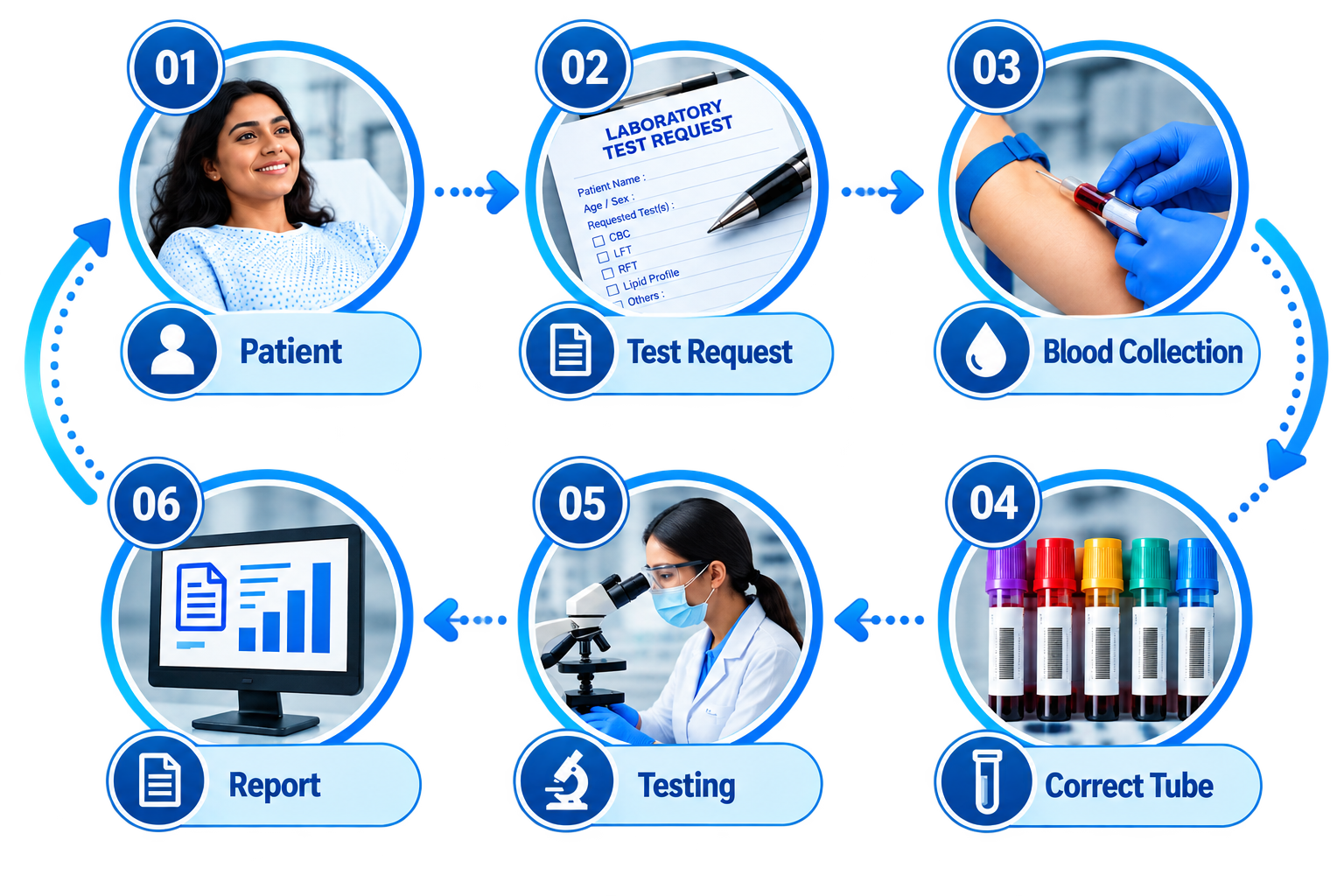
Step 2 — The Sample Is Prepared for the Road
Now comes the part most patients never see.
The sample needs to be packaged appropriately before transportation.
A blood tube should not be treated like an ordinary parcel. It is a biological specimen that needs protection against leakage, breakage and unsuitable handling.
WHO guidance recommends appropriate leak-proof packaging and protective arrangements for transporting laboratory specimens.
The precise packaging method depends on the specimen, laboratory requirements and transportation system.
This is why "just keep it cold" is not a sufficient transportation plan.
The sample needs the conditions specified for that particular test.
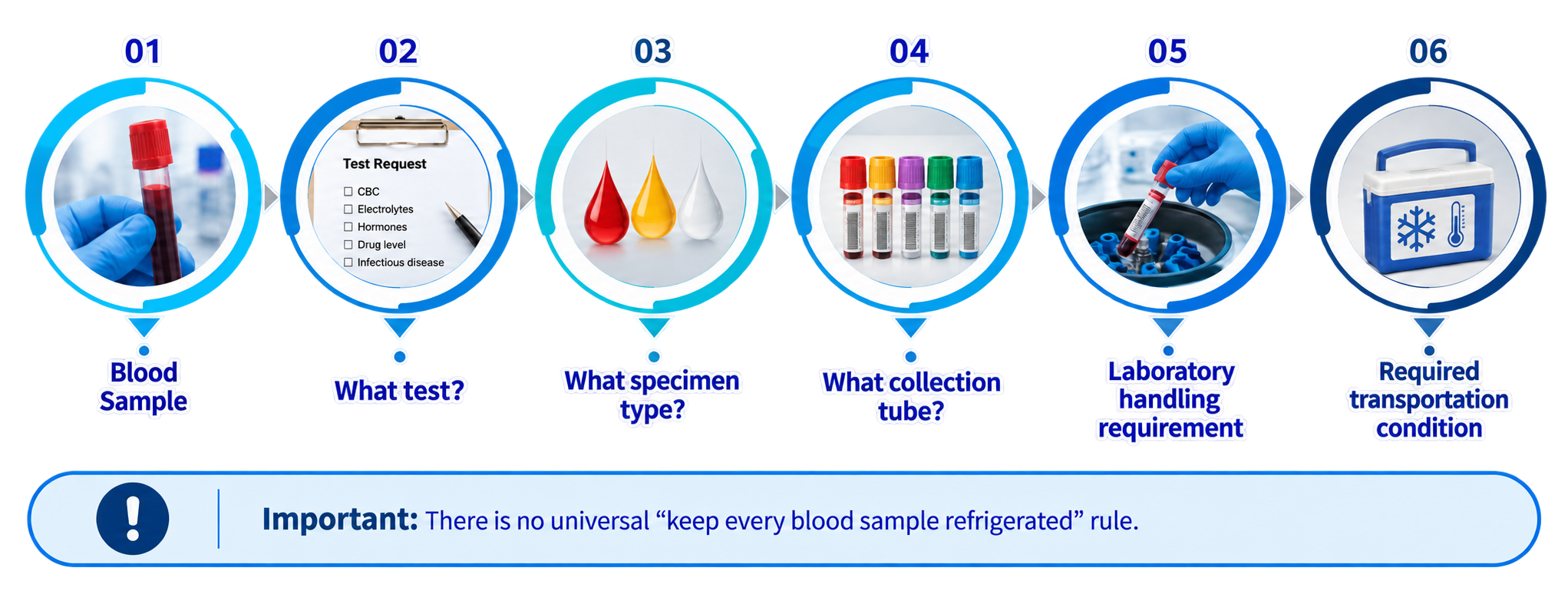
Step 3 — Does Every Blood Sample Need to Be Kept Cold?
This is where a lot of online advice goes wrong.
No, not every blood sample should automatically be refrigerated.
Different tests can have different specimen requirements.
The appropriate temperature can depend on:
- The type of blood specimen
- The collection tube
- The test being performed
- The laboratory's instructions
- The time between collection and processing
For certain specimens, controlled refrigeration may be required. For others, room-temperature handling or another specified condition may be appropriate.
CDC specimen instructions, for example, specify particular storage conditions for particular specimen types rather than applying one temperature rule to every blood sample.
The practical rule
Don't guess the temperature. Follow the laboratory's specimen-handling requirements.
This is especially important when diagnostic samples travel between different cities, collection centres and central laboratories.
Step 4 — The Sample Starts Its Medical Logistics Journey
The sample is now ready to move.
This is where transportation becomes more than simply driving from Point A to Point B.
The objective is to move the specimen:
Safely + within the required timeframe + under appropriate conditions + with traceability.
Imagine the difference between transporting a normal package and transporting a diagnostic specimen.
If a normal parcel arrives several hours late, the contents may still be perfectly usable.
A diagnostic specimen may have specific stability and handling requirements.
That doesn't mean every delay automatically ruins a blood sample. It means the transportation process should be designed around the requirements of the specimen rather than treating every package identically.
WHO laboratory quality guidance identifies timely transportation and suitable conditions as important considerations for maintaining specimen quality.
A Sample's Journey Depends on More Than Speed
Once a blood sample is collected at home, reaching the laboratory quickly is important, but speed alone does not guarantee sample quality.
During diagnostic sample transportation, the specimen also needs appropriate handling, protection, traceability and delivery to the correct laboratory.
A reliable process focuses on five factors:
Time
How quickly must the sample reach the laboratory?
Temperature
Does the specimen require specific temperature conditions during transport?
Protection
Is the tube protected from damage, leakage or unnecessary movement?
Traceability
Can the sample and its handovers be tracked throughout the journey?
Destination
Is the sample being delivered to the correct laboratory or processing facility?
Time → Temperature → Protection → Traceability → Destination
These five factors work together to support safe and reliable blood sample transportation from home to laboratory.
Step 5 — What Happens When the Sample Reaches the Laboratory?
The courier reaches the laboratory.
But again, testing doesn't necessarily start immediately.
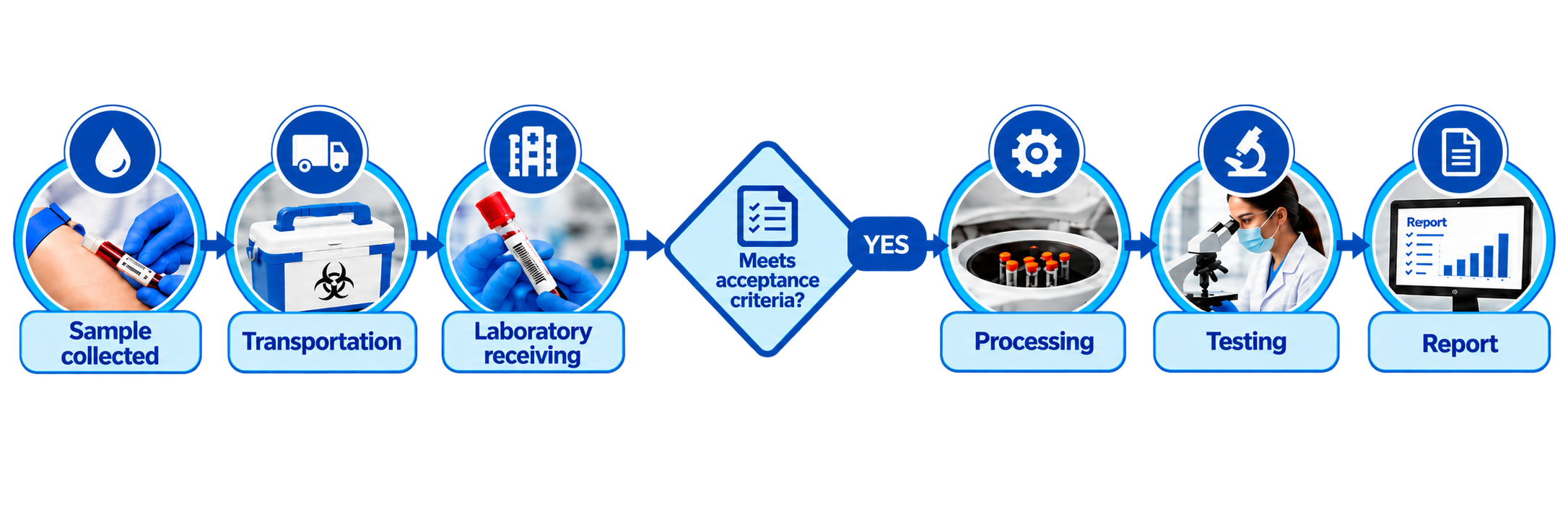
The laboratory receiving team first needs to accept the specimen into its workflow.
Depending on the laboratory's procedures and the test involved, staff may check things such as:
- Sample identification
- Patient details
- Requested investigation
- Tube type
- Sample volume
- Packaging condition
- Leakage or breakage
- Other specimen acceptance criteria
The laboratory has to determine whether the specimen is suitable for the requested testing.
This is an important quality-control checkpoint.
What If the Laboratory Rejects the Sample?
This is one of the situations patients generally never think about.
Suppose a patient had blood collected at home at 8:00 AM.
The sample reaches the laboratory later that morning, but the laboratory determines that it doesn't meet its acceptance requirements.
Depending on the reason and the particular test, another sample may need to be collected.
That means the patient may have to:
Book another collection → Give another blood sample → Wait for transportation again → Wait for processing again.
Nobody wants that.
This is why proper collection, packaging and transportation are not minor administrative details.
They can affect the efficiency of the entire diagnostic journey.
Important distinction
A laboratory rejecting a specimen doesn't necessarily mean the courier caused the problem.
A specimen can become unsuitable for many reasons, including collection-related issues, insufficient volume, incorrect tube selection or other factors.
The point is simply that every stage contributes to specimen quality.
Step 6 — The Blood May Need Preparation Before Testing
Now the sample has successfully entered the laboratory workflow.
But it may still not be ready for the analyser.
Depending on the investigation, the specimen may need preparation before testing.
This can include processes such as:
- Clotting when required
- Centrifugation
- Separation of serum or plasma
- Aliquoting
- Other test-specific preparation
For example, certain blood investigations require serum or plasma rather than whole blood.
WHO laboratory material describes centrifugation as a method used to separate serum or plasma from cellular components when required by the testing process.
So the tube collected at home may look exactly the same when it reaches the laboratory, but its next step depends entirely on the test ordered.
Step 7 — Finally, the Sample Is Tested
Only after the appropriate preparation does the sample move into the analytical stage.
Depending on the investigation, laboratory instruments may measure different substances, cells or biological markers.
The results then go through the laboratory's reporting process.
Eventually, the patient receives the report through the diagnostic provider's chosen system.
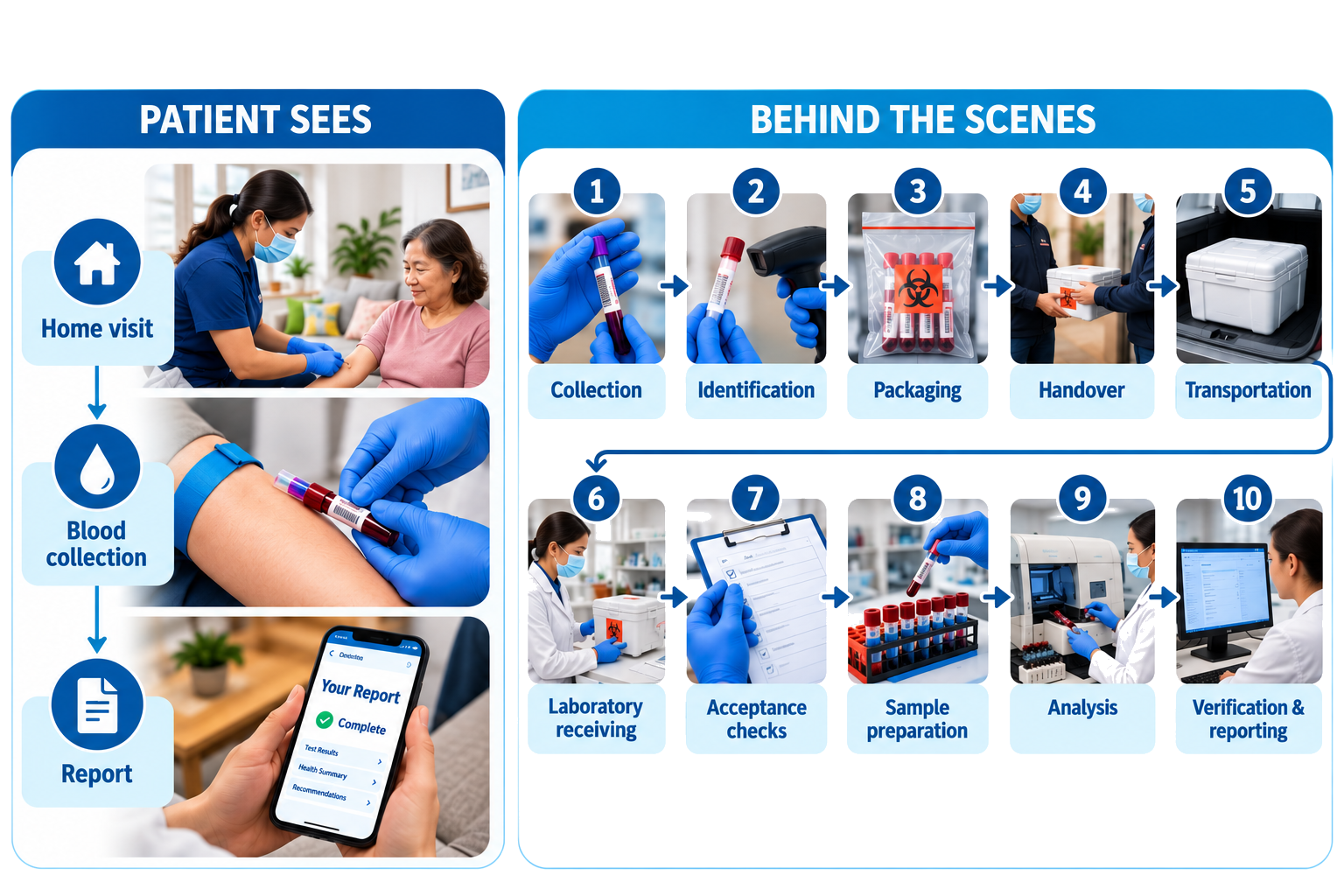
From the patient's perspective, the journey may look like:
Home → Blood collected → Report received.
Behind the scenes, the actual pathway is considerably longer.
What Patients Should Know About Home Blood Sample Collection
If you regularly use home diagnostic services, you don't need to understand every laboratory procedure.
But a few practical questions are worth asking.
Ask whether fasting is required
Some blood tests require fasting or other preparation.
Don't assume. Follow the instructions provided by your healthcare provider or diagnostic laboratory.
Give accurate information during booking
The laboratory needs the correct patient and test details to organise the appropriate collection.
Ask about the expected report time
Turnaround times vary according to the test and laboratory workflow.
If you need the result before a doctor's appointment, don't leave the timing to guesswork.
Don't assume all samples have the same transportation requirements
One of the biggest mistakes is applying the same handling rule to every blood tube.
Different specimens can have different requirements.
Choose providers with an organised process
Convenience is useful, but healthcare logistics should also be dependable.
A home collection service is only one part of the diagnostic chain.
The sample still needs to complete the journey to the right laboratory.
Why Medical Logistics Matters to Home Diagnostics
Home blood collection has changed the patient's experience of diagnostic testing.
The patient no longer necessarily needs to travel to a laboratory early in the morning.
But that convenience shifts part of the logistical challenge elsewhere.
The laboratory now needs a reliable way to receive specimens from multiple homes, clinics or collection points.
This creates a network:
- Patient
- Collection professional
- Medical logistics
- Laboratory
- Diagnostic report
The transportation stage connects the first and last parts of that network.
For healthcare organisations, the objective is not simply to move specimens.
It is to build a process in which specimens can be collected, protected, transported and received according to their requirements.
A Simple Example: One Blood Test, Two Very Different Journeys
Consider two hypothetical samples.
Journey A — Organised transportation
- A sample is collected correctly.
- It is identified immediately.
- It is placed into appropriate protective packaging.
- The required transportation conditions are maintained.
- It reaches the intended laboratory within the required timeframe.
- The laboratory receives and accepts it.
Result: the specimen continues through the normal testing workflow.
Journey B — Poorly managed transportation
- A sample is collected.
- Identification or documentation is incomplete.
- Packaging is inadequate.
- Transportation is delayed.
- The specimen arrives at the laboratory and doesn't meet the laboratory's acceptance requirements.
Result: additional investigation or recollection may be necessary, depending on the circumstances.
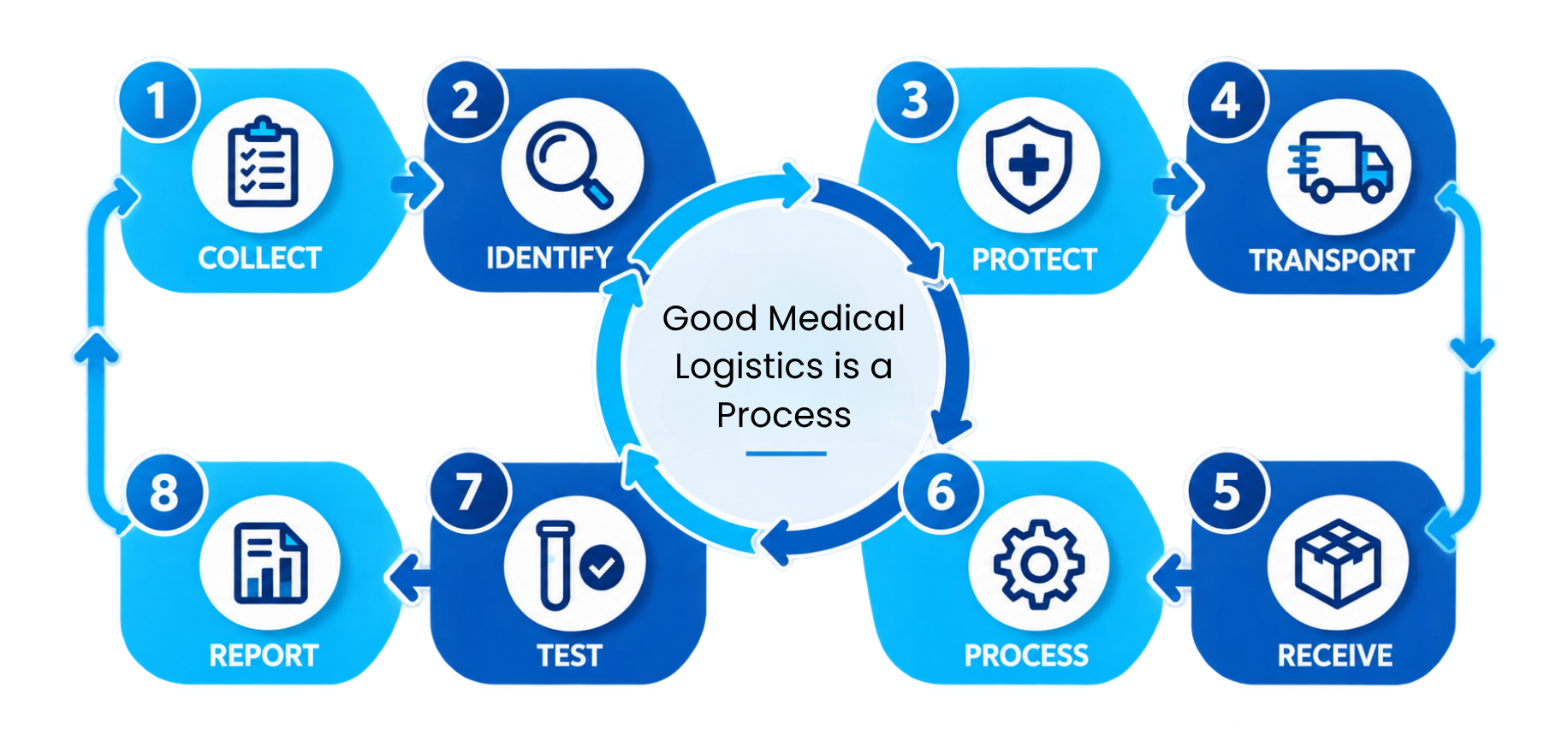
The difference isn't simply the vehicle.
It is the process surrounding the vehicle.
The Takeaway: Your Blood Sample Has a Journey of Its Own
The next time someone collects your blood sample at home, don't think of the process as ending when the needle comes out.
Think of it as a handover.
The collection professional has completed one part of the journey.
The sample then needs to be correctly identified, protected, transported and received by the laboratory before it can move into testing.
That is why healthcare logistics deserves more attention than it usually gets.
A diagnostic result starts with a specimen, but a specimen only becomes useful when its entire journey is managed properly.
For diagnostic networks, hospitals, laboratories and healthcare providers, reliable medical logistics helps connect collection points with the facilities responsible for processing and testing.
At C3 Logistics, the focus is on supporting healthcare transportation requirements with an understanding that medical specimens are not ordinary parcels. Their movement needs to be organised around safety, handling, timing and the requirements of the healthcare workflow.
Frequently Asked Questions
What happens to a blood sample after home collection?
After collection, the sample is identified and prepared for transportation. It then travels to the appropriate laboratory, where it may be checked, accepted, processed and finally tested.
How is a blood sample transported from home to a laboratory?
The sample should be transported using appropriate packaging and handling procedures based on the specimen and laboratory requirements. The exact process can vary according to the test and healthcare provider.
Does every blood sample need refrigeration?
No. Storage and transportation conditions vary according to the specimen and test. Some samples require controlled refrigeration, while others have different requirements.
What happens if a blood sample reaches the laboratory late?
The effect depends on the particular specimen and test. Some specimens are more time-sensitive than others. The laboratory determines whether the sample remains suitable according to its acceptance and testing requirements.
Can a blood sample be rejected by a laboratory?
Yes. A laboratory may reject a specimen if it does not meet applicable acceptance requirements. Reasons can include identification problems, inadequate specimens, leakage, unsuitable collection materials or other issues.
Why is blood sample transportation important?
Transportation is part of the pre-analytical stage of laboratory testing. Poor handling, unsuitable conditions or excessive delays can affect specimen quality and may interfere with the testing workflow.
Final Checklist for a Reliable Home Blood Sample Journey
Before considering the process complete, think about these seven stages:
| Stage | What needs attention |
|---|---|
| 1. Collection | Correct blood collection procedure |
| 2. Identification | Accurate patient/sample matching |
| 3. Packaging | Appropriate protection and containment |
| 4. Conditions | Test-specific handling requirements |
| 5. Transportation | Safe and timely movement |
| 6. Laboratory receiving | Specimen acceptance checks |
| 7. Testing | Preparation, analysis and reporting |
The important lesson is simple:The quality of a diagnostic journey doesn't depend on one step. It depends on how well the steps connect.