Healthcare logistics is easy to describe as "moving medical products."
That definition is too narrow.
A hospital needs supplies. A laboratory needs specimens. A pharmacy needs medicines. A healthcare provider may need equipment moved between facilities. Some products need controlled temperatures, while some diagnostic specimens have specific collection, handling and transport requirements.
All of these movements sit inside a larger system.
Healthcare logistics is the planning, coordination, handling, storage and transportation of healthcare-related products, supplies, equipment and diagnostic materials according to the requirements of each item and the healthcare workflow.
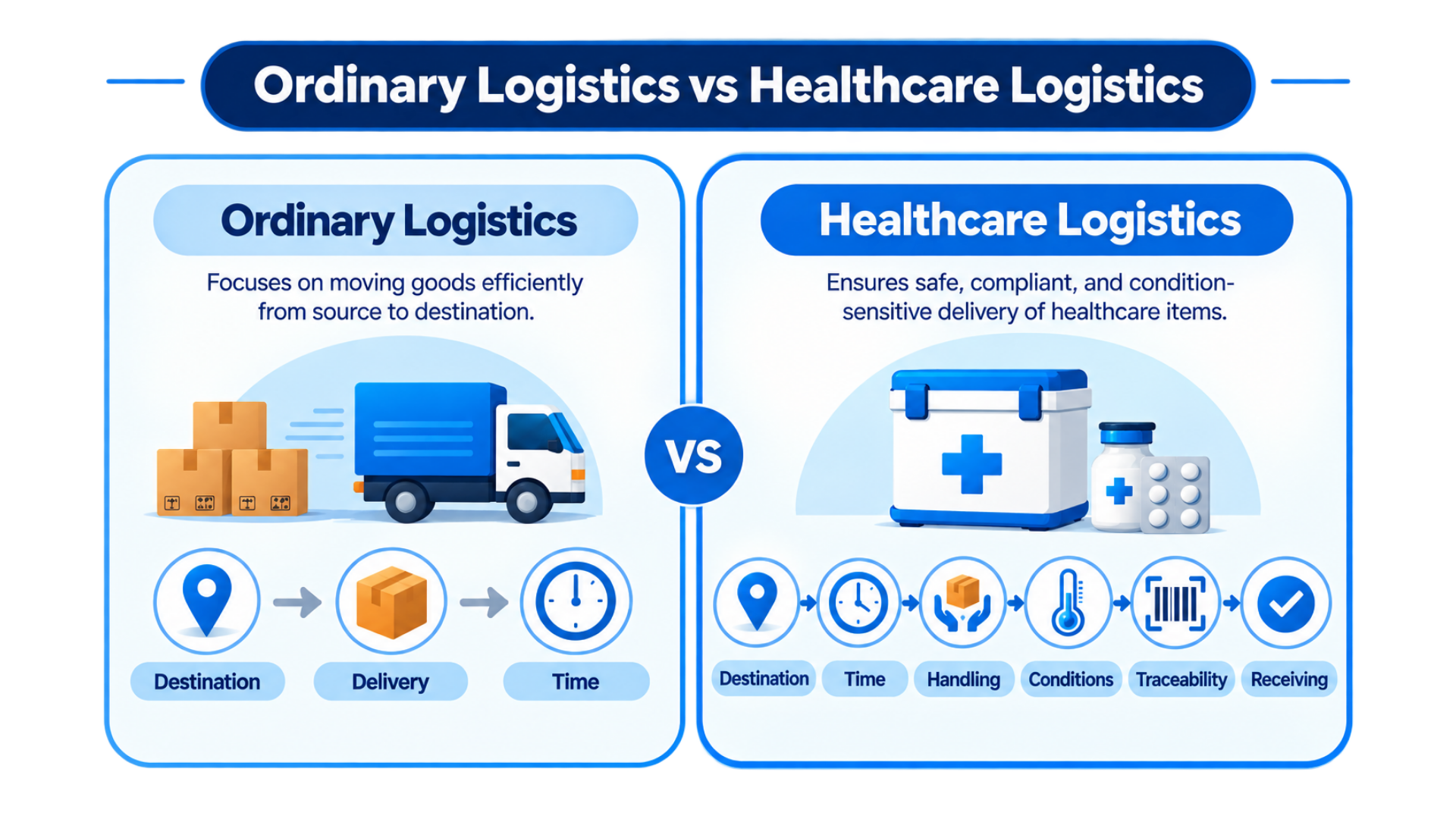
What makes it different from ordinary logistics is not simply the type of vehicle used. It is the level of control required around what is being moved.
What Does Healthcare Logistics Actually Cover?
Healthcare logistics is not one service. It is a collection of connected activities.
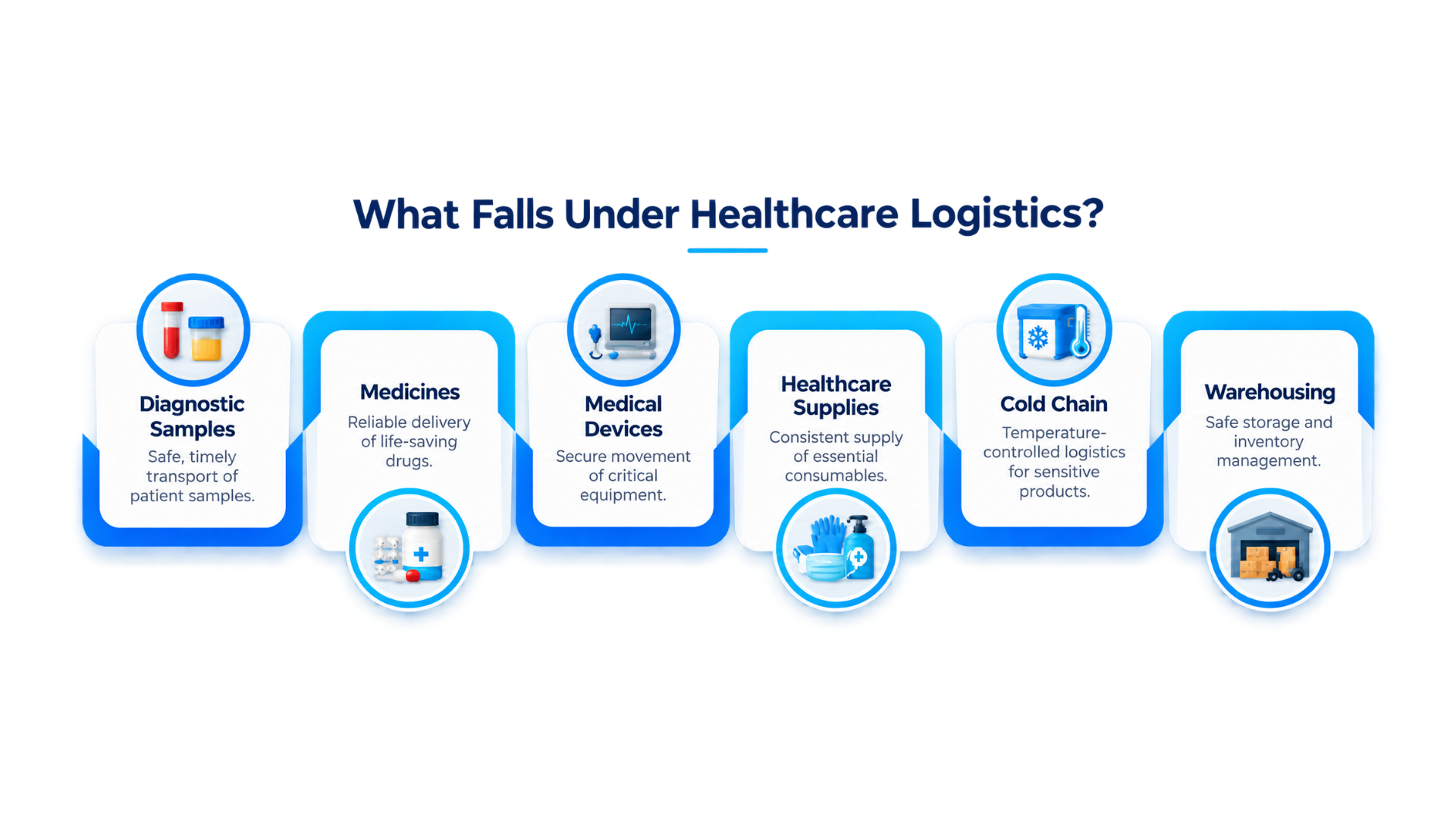
Depending on the healthcare operation, it may include:
Diagnostic logistics
Movement of blood, pathology and other diagnostic specimens from collection locations to laboratories.
Medical product logistics
Transportation and distribution of medicines, healthcare products and related materials.
Medical equipment logistics
Movement of medical devices, laboratory equipment and other healthcare hardware.
Healthcare supply logistics
Distribution of consumables and supplies required by hospitals, laboratories and clinics.
Cold chain logistics
Controlled transportation and storage for temperature-sensitive materials.
Healthcare warehousing
Storage and inventory movement where the healthcare product requires controlled or specialized conditions.
This broader view matters because the logistics requirement changes according to the thing being moved.
Why Healthcare Logistics Is Different From General Logistics
Imagine a blood sample collected from a patient at home is on its way to a diagnostic lab. The pickup is complete, but the journey is not just about reaching the destination on time.
Unlike an ordinary parcel, a diagnostic specimen may require specific temperature conditions, careful handling, secure packaging and timely delivery to remain suitable for testing.
What if the pickup is delayed or the sample is exposed to unsuitable conditions? The laboratory may need to assess whether it is still acceptable for testing.
That's what makes healthcare logistics different: it's not just about moving a sample from one place to another — it's about protecting its integrity throughout the journey.
How Does Healthcare Logistics Work?
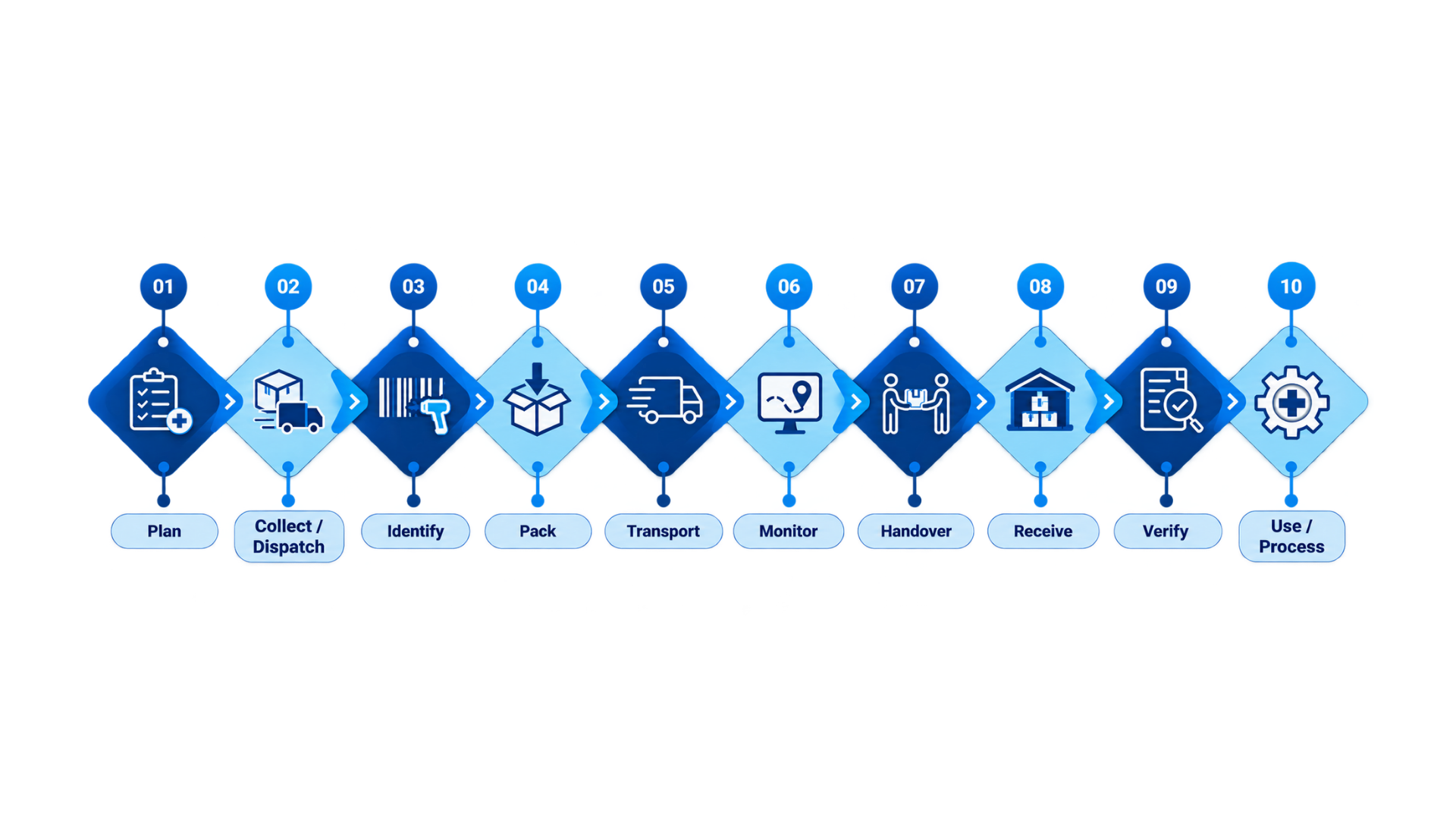
A healthcare logistics journey usually follows a connected chain rather than a single delivery event.
A simplified workflow looks like this:
Planning → Collection or Dispatch → Identification → Packaging → Transportation → Monitoring → Handover → Receiving → Verification → Final Use or Processing
The exact workflow changes depending on the material.
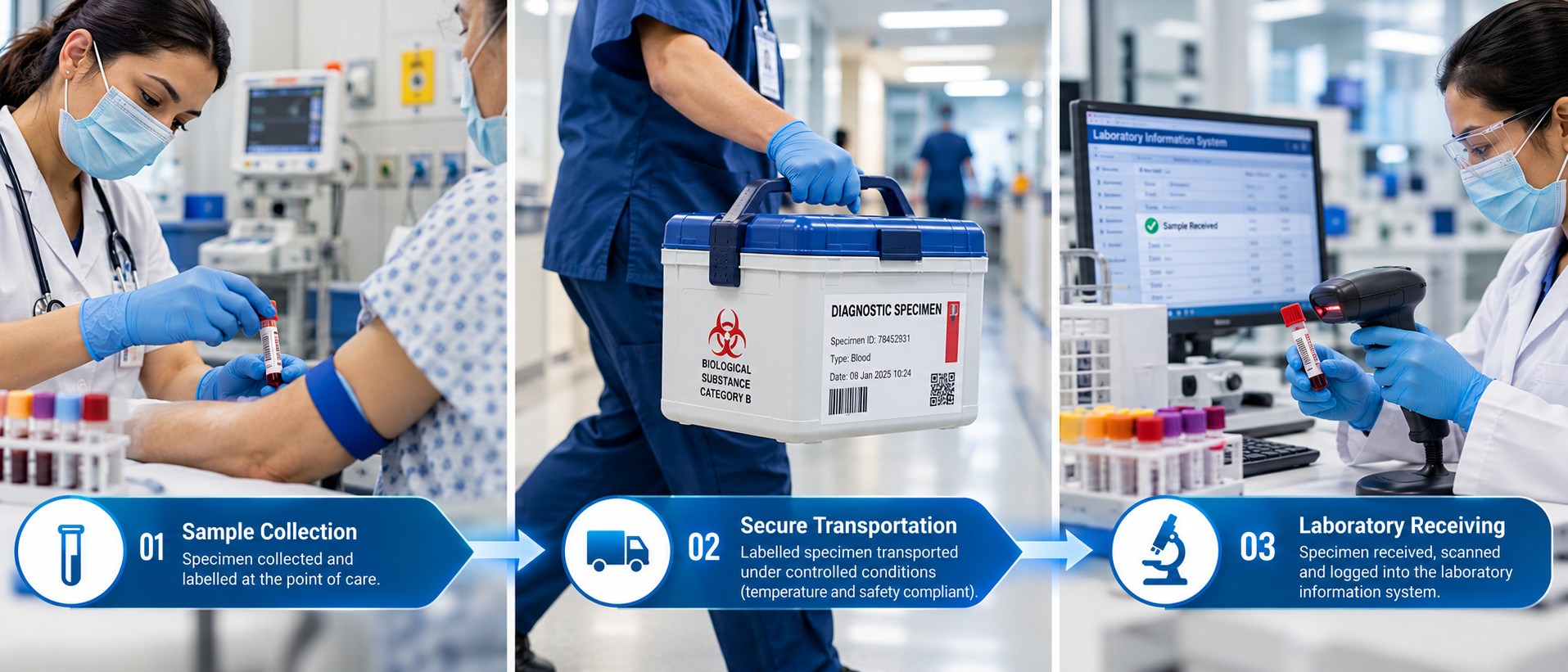
For example, a diagnostic specimen may move through:
Patient or Collection Point → Sample Collection → Labelling → Packaging → Transportation → Laboratory Receiving → Processing → Testing
A pharmaceutical shipment may follow a different path involving manufacturing, storage, distribution and final delivery.
This is why there is no single "standard" healthcare logistics model.
Diagnostic Specimen Logistics Needs a Different Mindset
A sample collected correctly can still face problems before it reaches the laboratory. Imagine a diagnostic lab receiving specimens from multiple collection centres and patients' homes. One pickup is delayed, another sample arrives with damaged packaging, and a third has an identification mismatch.
These aren't simply delivery issues. Each may require a different response before the laboratory can proceed.
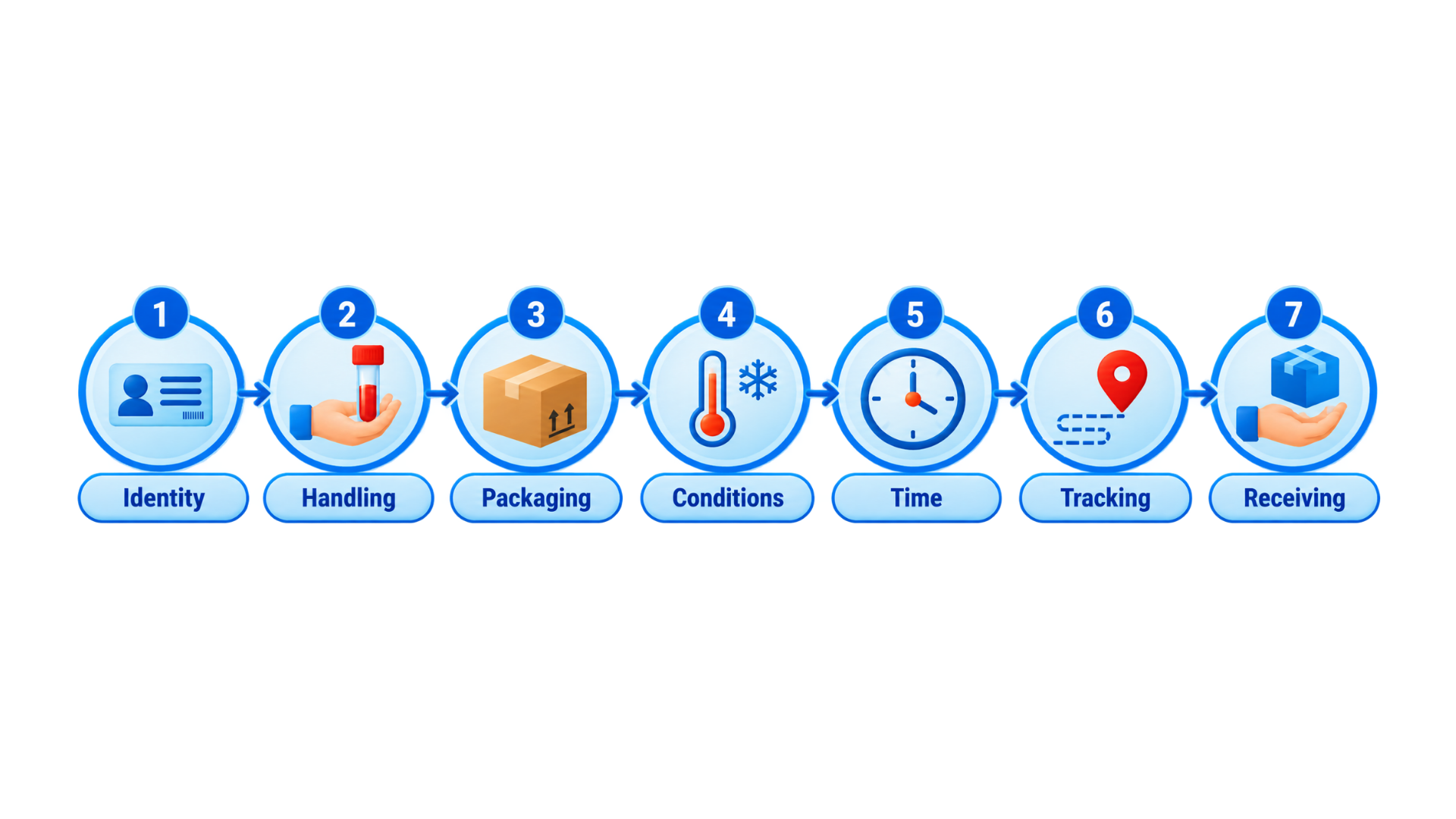
Diagnostic specimen transportation must account for six key factors:
Identification
Can the specimen be matched to the correct patient and test request?
Packaging
Is it packed appropriately to prevent leakage, damage and contamination?
Transport conditions
Have the specimen-specific requirements been followed?
Transit time
Has the sample remained within the applicable stability limits?
Traceability
Can its journey and handovers be tracked?
Laboratory handover
Can the receiving team verify the specimen and assess its suitability for testing?
The ICMR's Good Clinical Laboratory Practice guidance highlights the importance of preserving sample integrity and stability during transportation, including for samples collected outside the laboratory. Personnel involved in handling and transport should follow relevant procedures and receive appropriate training.
This is why diagnostic sample transportation is more than a courier function. It is an important part of the pre-analytical workflow, connecting sample collection with laboratory receipt while helping protect specimen quality.
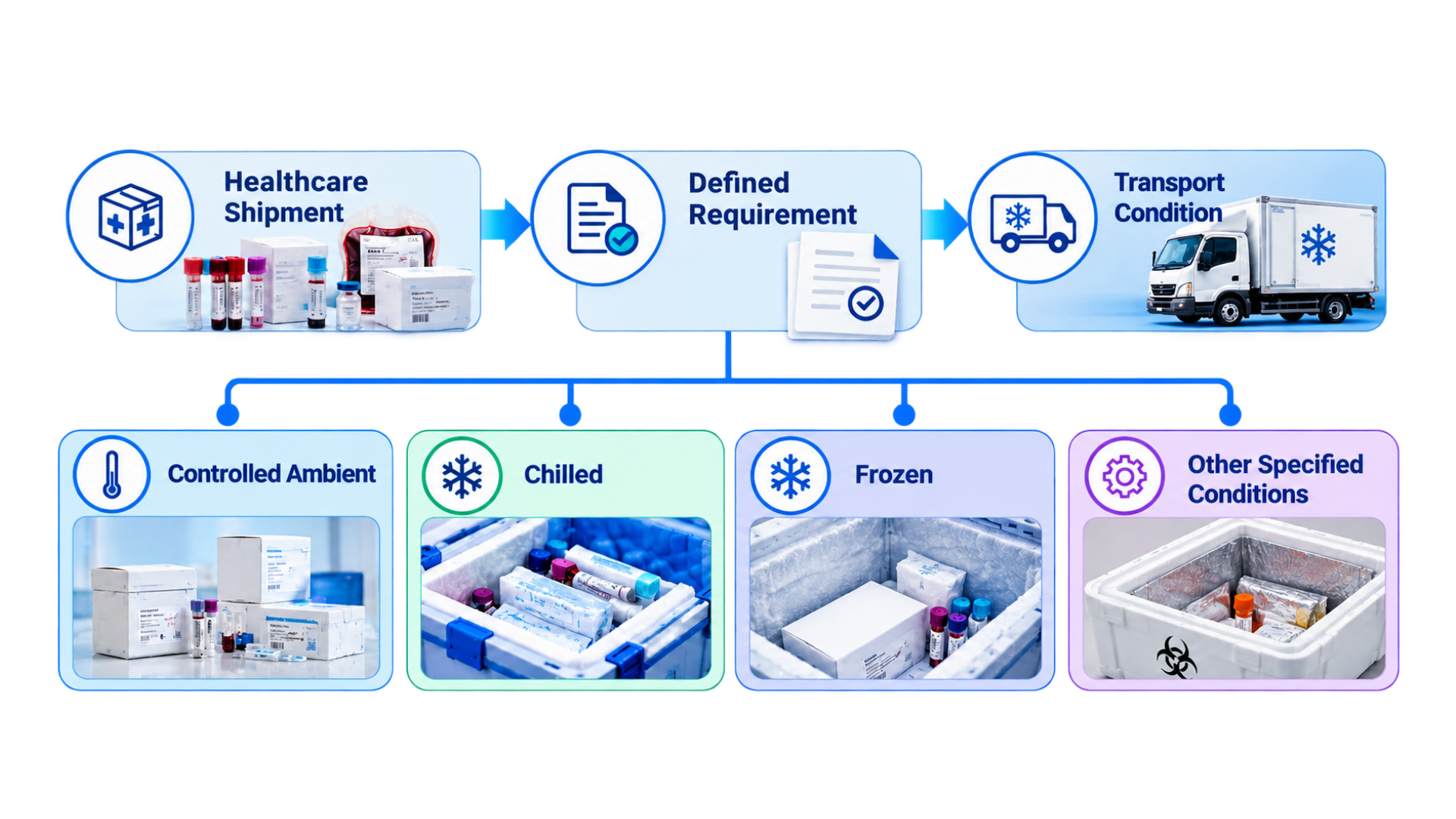
Why Temperature Control Matters
Temperature is one of the most visible parts of healthcare logistics, but it should not be treated as a universal rule.
Different healthcare products and specimens can have different requirements.
For pharmaceutical and biological products, Indian regulatory guidance addresses validated temperature-control systems, temperature monitoring, seasonal variation and procedures for unexpected events such as vehicle breakdowns or temperature excursions.
The practical principle is:
Do not assume that "cold" means safe for every healthcare shipment. Follow the defined requirements for the particular product or specimen.
Temperature management can involve more than a refrigerated vehicle. Depending on the shipment, the logistics process may involve suitable packaging, monitoring equipment, documented procedures and response plans.
What Happens When a Healthcare Shipment Is Delayed?
A delay does not have the same meaning for every shipment.
The impact depends on what is being transported and what requirements apply to it.
For a diagnostic specimen, the laboratory may need to consider whether the sample remains suitable under its acceptance criteria.
For a temperature-sensitive product, a delay may create a different concern if required environmental conditions cannot be maintained.
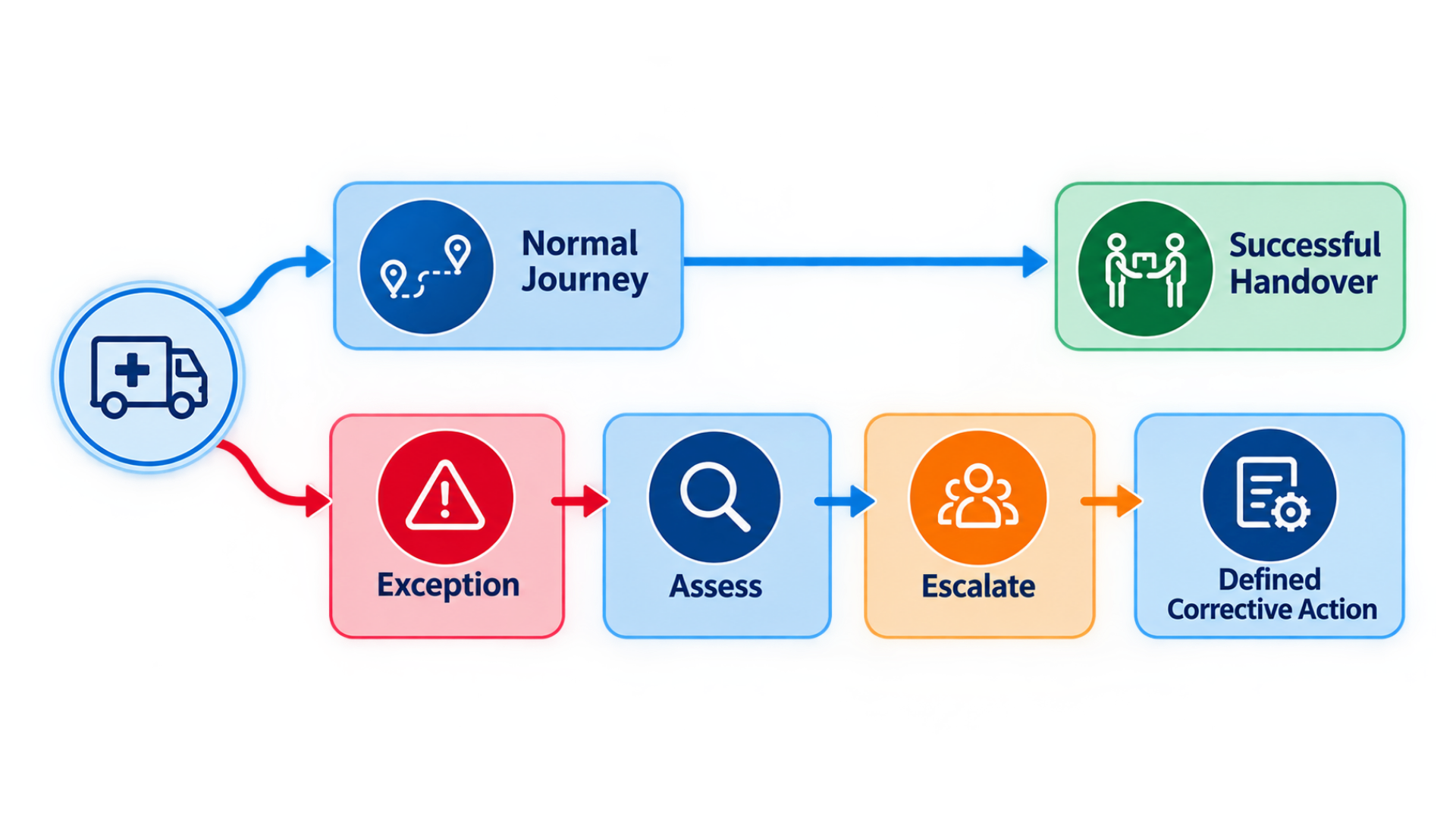
For this reason, healthcare logistics planning needs an exception process, not just a delivery route.
A mature workflow should define what happens when:
- A vehicle is delayed
- A pickup is missed
- A package is damaged
- A temperature deviation occurs
- A shipment reaches the destination late
- A receiving facility cannot accept the shipment
The goal is not to eliminate every possible disruption.
It is to make sure the response is defined before the disruption occurs.
Visibility Is More Than Knowing Where a Shipment Is
Tracking is often presented as simply knowing the location of a shipment.
In healthcare logistics, visibility can be broader.
Depending on the operation, useful information may include:
Location → Pickup Time → Transit Status → Handover → Receiving Time → Condition Data
For temperature-sensitive logistics, monitoring technology can also provide condition data. Hellmann and DHL both emphasize digital visibility, temperature monitoring and proactive intervention as components of their healthcare logistics models.
For diagnostic logistics, traceability can help connect a specimen with its collection and laboratory journey.
That turns tracking from a convenience feature into an operational control tool.
Healthcare Logistics in India: Why Network Design Matters
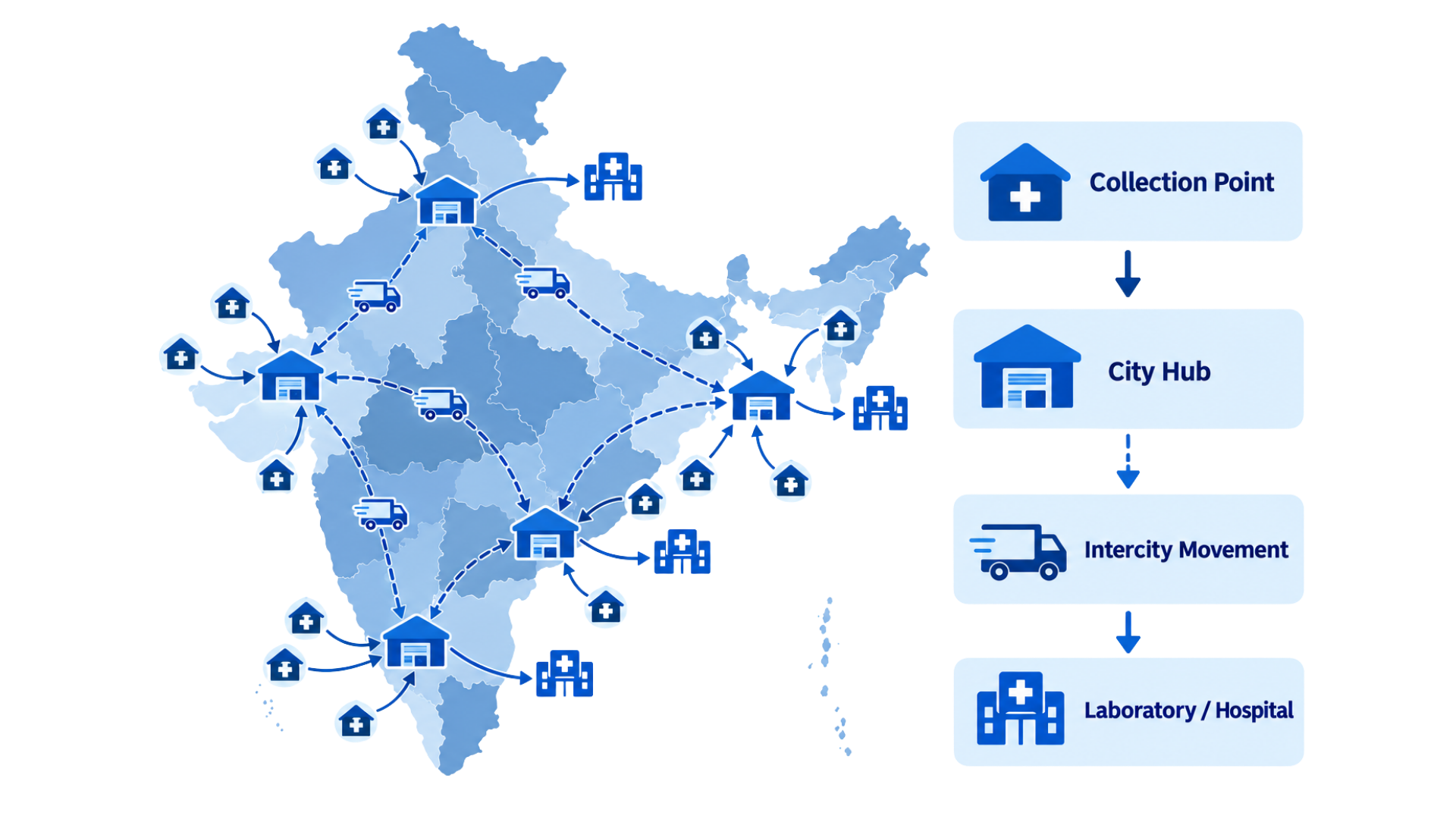
India's healthcare network is spread across major cities, regional centres, collection facilities, hospitals, laboratories and more remote locations.
That creates a logistics environment where a healthcare shipment may require a combination of local collection, road movement, intercity transportation and laboratory or facility handover.
The network therefore has to account for more than distance.
It needs to consider:
- Where healthcare materials originate
- Where they need to go
- How frequently they move
- Whether the route is local or intercity
- What handling conditions are required
- Where handovers occur
- What happens when the planned route is disrupted
India's healthcare logistics environment also includes specific regulatory frameworks. CDSCO maintains guidance covering areas such as pharmaceutical good distribution practices and biological-product transportation conditions.
What Should Healthcare Organizations Evaluate?
A healthcare logistics system should be evaluated around the requirements of the healthcare operation, not only the delivery price or speed.
Useful questions include:
Can the process protect the material?
Does the logistics model match the handling requirements of the shipment?
Can the journey be traced?
Can the relevant collection, transportation and handover events be recorded?
Can exceptions be managed?
Is there a defined response when something goes wrong?
Can the network scale?
Can the process handle more locations, more shipments and more complex routing without losing control?
Does transportation fit the healthcare workflow?
Can logistics work effectively with laboratory receiving, hospital operations, pharmacy processes or other healthcare functions?
These questions help distinguish transport capacity from healthcare logistics capability.
Healthcare Logistics Is a Chain of Controls
The simplest way to understand healthcare logistics is to stop thinking of it as a vehicle movement.
It is a chain of controls.
- What is it?
- Where is it going?
- How should it be handled?
- What conditions does it require?
- How long can the journey take?
- Can the movement be traced?
- What happens when something changes?
These questions are what turn transportation into a healthcare logistics process.
Frequently Asked Questions
What is healthcare logistics?
Healthcare logistics is the coordinated planning, handling, storage and movement of healthcare-related products, supplies, equipment and diagnostic materials according to their specific requirements.
What are examples of healthcare logistics?
Examples include diagnostic sample transportation, medical courier operations, pharmaceutical logistics, medical equipment movement, healthcare supply distribution and temperature-controlled logistics.
How is healthcare logistics different from normal logistics?
Healthcare logistics may involve additional controls for handling, timing, temperature, traceability, documentation and receiving because the requirements depend on the healthcare material being transported.
What is diagnostic logistics?
Diagnostic logistics refers to the collection, handling and transportation of diagnostic specimens from healthcare collection locations to laboratories as part of the wider laboratory workflow.
Does every healthcare shipment require temperature-controlled transportation?
No. Temperature requirements depend on the specific product or specimen and its defined handling requirements.
Why is healthcare logistics important for laboratories?
Laboratories depend on specimens reaching them in a condition suitable for their testing and receiving procedures. Transportation is therefore connected to the broader pre-analytical process.
Final Takeaway
Healthcare logistics is more than moving something from one address to another.
It connects collection, handling, transportation, monitoring, handover and receiving into a controlled healthcare workflow.
The exact logistics model depends on what is being moved.
A diagnostic specimen has different considerations from a medicine, a medical device or a hospital supply. Temperature-sensitive products introduce another layer of control. Growing healthcare networks introduce more collection points, routes and handovers.
The central principle remains the same:
Healthcare logistics works when the journey is designed around the requirements of the healthcare material, not simply around the vehicle carrying it.