A Medical Sample's Journey Doesn't End at Collection
A laboratory result may be generated inside a sophisticated diagnostic facility.
But the journey behind that result starts much earlier.
It may begin at a patient's home. It may begin at a hospital. It may begin at a diagnostic collection centre hundreds of kilometres away from the testing laboratory.
And between that collection point and the laboratory, something critical has to happen:
The sample has to move safely, correctly and within the required conditions.
That sounds simple. It isn't.
- The sample needs to be correctly identified.
- It may require specific packaging.
- Some specimens have defined temperature requirements.
- A pickup needs to happen at the right time.
- The route may involve multiple locations or transport modes.
- And the receiving laboratory needs visibility into what is arriving and whether the specimen meets its acceptance requirements.
That entire operational layer is where healthcare logistics becomes critical.
A diagnostic laboratory can have advanced equipment and highly skilled technicians, but if a specimen does not reach the laboratory properly, the testing workflow can still face delays, rejection or additional operational work.
So what actually happens between sample collection and laboratory testing? Let's follow the journey.
What Is Healthcare Logistics?
Healthcare logistics is the planned movement and management of healthcare-related materials, information and services between the locations where they are collected, stored, transported, received or used.
In diagnostic operations, this includes the movement of patient specimens from collection locations to laboratories.
But medical laboratory logistics is more than transportation. A typical process may involve:
Sample collection → Identification → Packaging → Pickup → Transportation → Temperature management → Tracking → Laboratory handover → Sample reception
Each stage has a purpose.
If one stage is poorly managed, the next stage inherits the problem.
That is why healthcare logistics should be viewed as a connected operational system, rather than simply a courier service.
WHO guidance for specimen transport highlights the importance of classification, packaging, marking, labelling, documentation, temperature requirements and trained personnel where applicable to transported biological materials.
Why Is Medical Sample Transport Different From Regular Delivery?
A parcel can often tolerate a delayed delivery. A diagnostic specimen may not have the same flexibility.
A medical sample can have requirements related to:
- Time
- Temperature
- Packaging
- Identification
- Handling
- Documentation
- Security
- Laboratory acceptance criteria
This creates a fundamental difference.
Regular delivery asks
"Can we get this package from A to B?"
Healthcare logistics asks
"Can we move this specimen from A to B while preserving the conditions required for its intended testing?"
That difference changes everything from packaging to route planning and laboratory handover.
WHO laboratory quality guidance states that laboratories should have procedures to monitor transportation so samples reach the laboratory within appropriate time, temperature and preservation conditions.
How Does Medical Laboratory Sample Transport Work?
The easiest way to understand medical laboratory logistics is to follow one specimen through its complete journey.
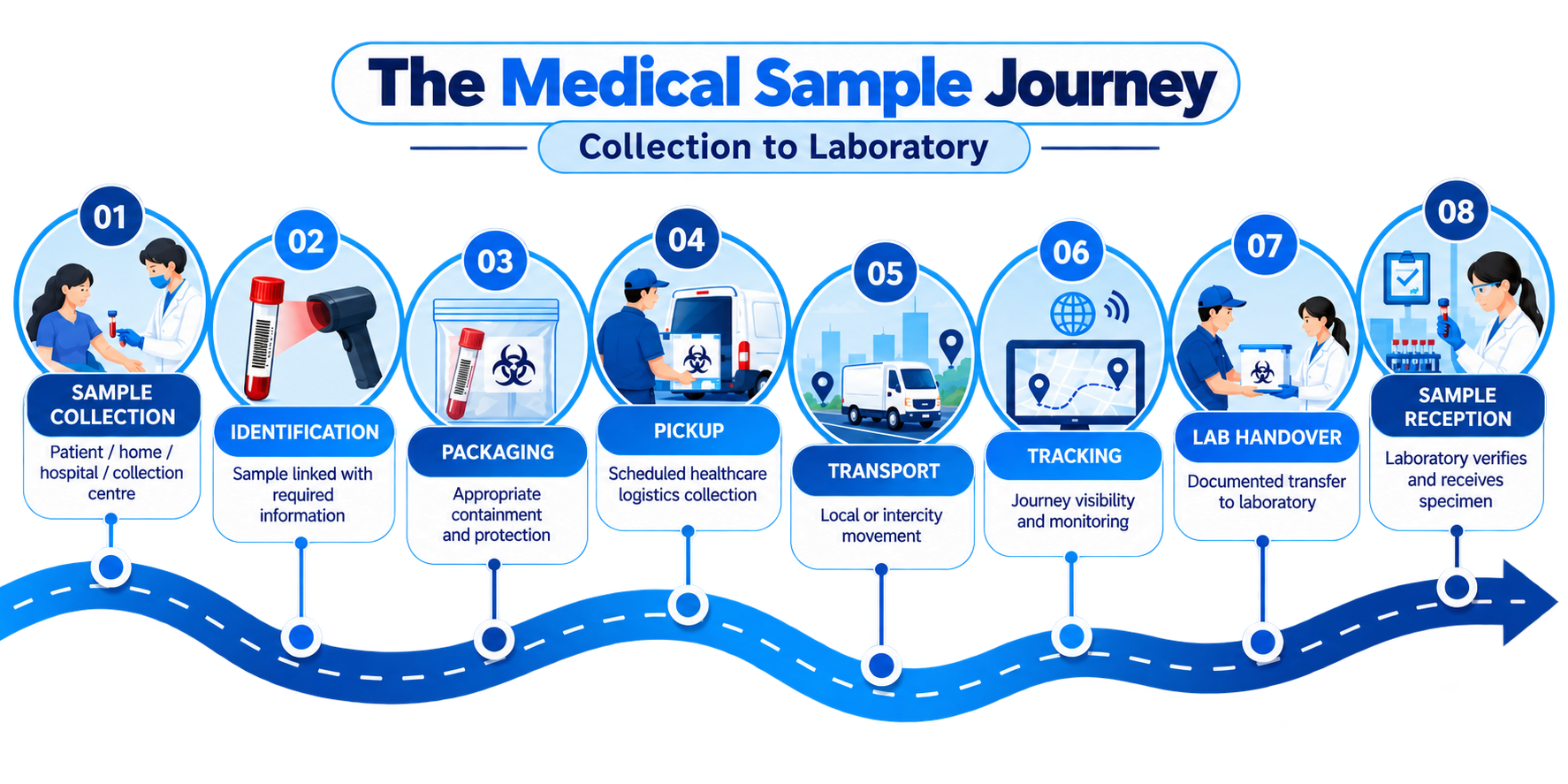
1. Sample Collection Starts the Logistics Journey
The logistics process begins before the sample enters a vehicle. It begins at collection.
A patient may provide a sample at:
- Home
- Hospital
- Diagnostic centre
- Collection centre
- Corporate healthcare location
- Other healthcare facilities
For example, consider a home blood collection. A phlebotomist reaches the patient's location, performs the required collection procedure, identifies the specimen and prepares it for onward movement.
At that moment, the sample becomes part of a logistics network. And timing immediately matters.
The collection time can influence when the sample should be picked up, transported and received.
This is why home collection and logistics cannot be treated as completely separate functions.
A collection operation that generates samples faster than the transportation network can move them simply creates a bottleneck downstream.
2. Identification Keeps the Sample Connected to Its Request
Imagine a laboratory receiving hundreds or thousands of specimens from multiple locations.
The receiving team needs to establish:
- What is this sample?
- Where did it come from?
- What testing is required?
- When was it collected?
- Has it remained within the required handling conditions?
That is why identification and documentation are fundamental parts of laboratory sample logistics.
A properly controlled process connects the specimen to its associated information throughout the journey. The chain looks something like this:
Patient / source → Sample identification → Collection record → Transport record → Laboratory receipt
The objective is traceability.
If something goes wrong, the organization should be able to investigate what happened rather than simply discovering that a sample is missing or delayed.
3. Packaging Protects the Sample During Transportation
Putting a specimen into a bag and sending it with a courier is not a healthcare logistics strategy.
Packaging needs to be appropriate for the specimen and applicable transport requirements.
Depending on the material and classification, packaging may need to protect against:
- Leakage
- Breakage
- External contamination
- Physical impact
- Temperature changes
- Movement during transit
WHO's transport guidance addresses classification, packaging, marking, labelling and documentation requirements for applicable biological materials.
For applicable diagnostic specimens, packaging systems can involve multiple protective layers. The basic concept:
Primary container
The specimen container.
Secondary packaging
Provides containment and protection.
Outer packaging
Provides additional protection during transport.
The exact packaging configuration should always follow the applicable specimen classification, test requirements and current regulatory requirements.
4. Temperature Control Can Make or Break the Transport Process
Here is where medical sample transport becomes considerably more complex.
Not every specimen travels under the same conditions. Depending on the specimen and testing requirement, transportation may involve:
- Ambient conditions
- Controlled room temperature
- Refrigerated conditions
- Frozen conditions
Therefore, the question isn't simply: "How fast can we deliver the sample?"
It is:
"How do we move the sample within the conditions required for that particular journey?"
This is the foundation of cold chain logistics.
A temperature-controlled logistics process can involve appropriate packaging, insulated containers, temperature-maintaining materials and, where required, monitoring systems.
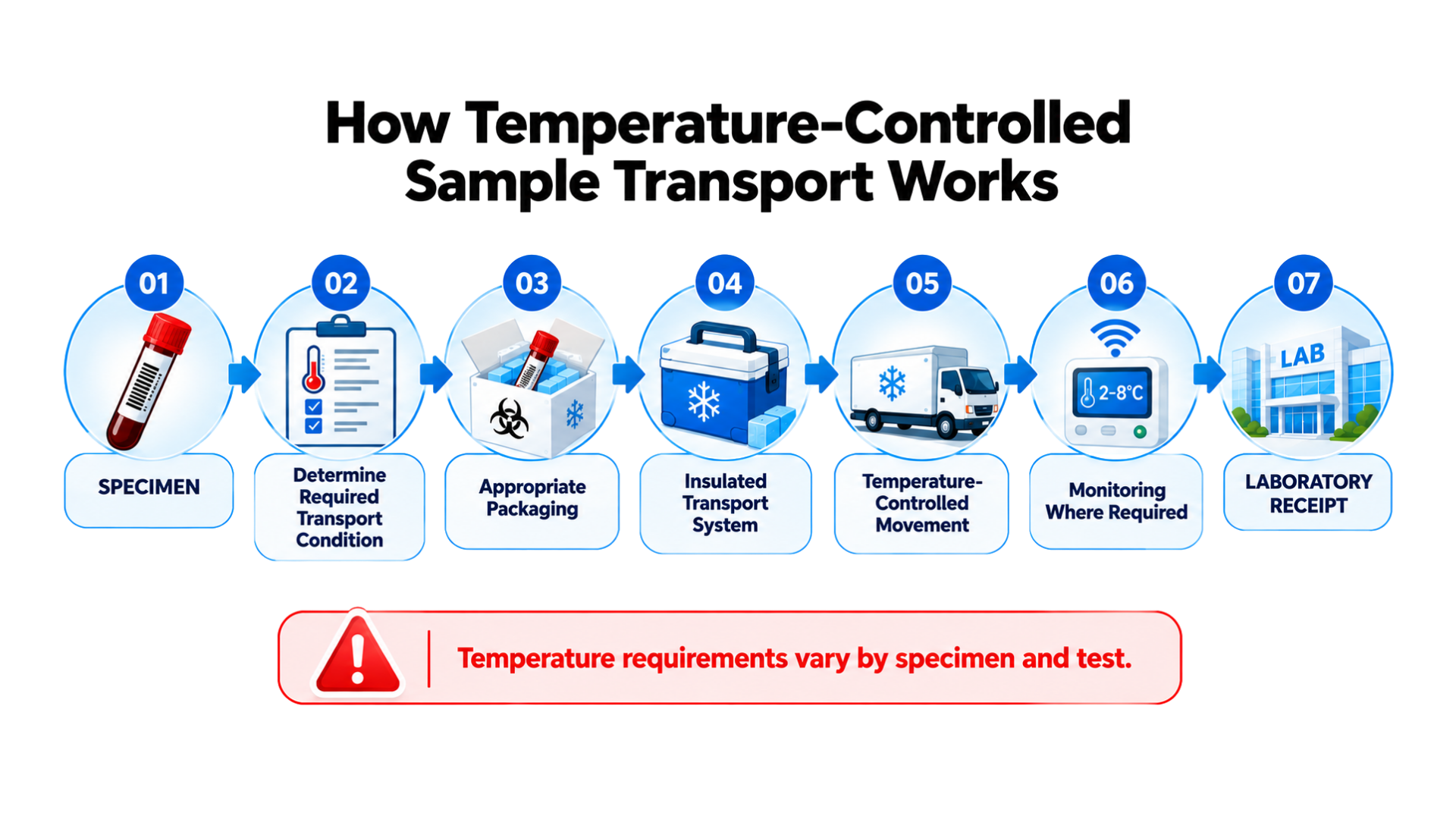
5. Pickup Timing Is More Important Than Simply Having a Courier
A healthcare logistics network needs to coordinate when a sample becomes available with when it needs to reach the laboratory.
That creates a scheduling problem. A logistics team may need to coordinate:
- Collection schedules
- Pickup windows
- Courier availability
- Traffic
- Route density
- Laboratory receiving hours
- Processing cut-offs
- Priority shipments
- Local and intercity movements
For a single nearby collection centre, this might be relatively straightforward. For a diagnostic network receiving samples from multiple cities, it becomes much more complicated.
Consider this:
10:00 AM collection does not automatically mean 10:00 AM pickup — and it certainly does not guarantee same-day laboratory processing.
There may be route planning, consolidation, transit and receiving windows between those events.
Good healthcare logistics connects these stages rather than treating them as isolated activities.
6. Local and Intercity Sample Transport Require Different Planning
A five-kilometre journey and a five-hundred-kilometre journey are not the same logistics problem.
Local sample transport
A simplified local route could be:
Collection Point → Pickup → Laboratory
The major considerations are usually:
- Pickup timing
- Route optimization
- Traffic
- Laboratory cut-off
- Fast handover
Intercity sample transport
The chain can become:
Collection Point → Local Pickup → Origin Network → Transit → Destination Network → Laboratory
This introduces additional coordination. There may be multiple transport modes, handovers and timing dependencies.
C3 currently describes a multimodal healthcare logistics network using air, road and rail, with operations across 452+ cities and 20,000+ pincodes, according to its website.
That matters because healthcare logistics at national scale is fundamentally a network-management problem, not simply a last-mile delivery problem.
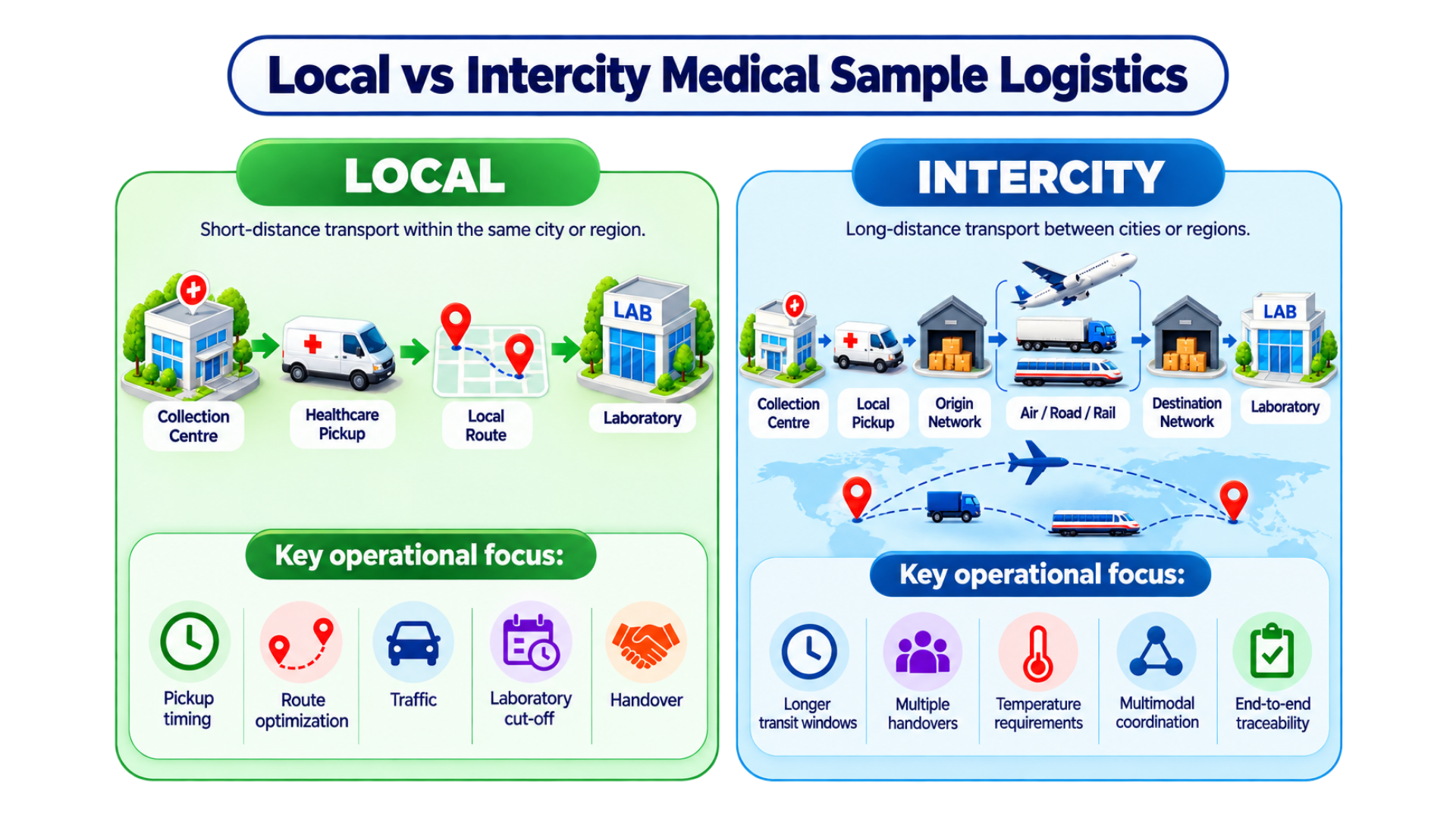
7. Tracking Creates Visibility Between Collection and Laboratory
One of the biggest weaknesses in a poorly managed logistics network is the black box between pickup and delivery.
The sample leaves the collection location. Then everyone waits.
A better system creates visibility throughout the journey. A simplified tracking flow can look like:
Collected → Picked Up → In Transit → Arrived at Destination → Handed Over → Received by Laboratory
Depending on the system, visibility can be supported through:
- Barcode scanning
- Mobile applications
- GPS
- Digital manifests
- Electronic proof of delivery
- Temperature-monitoring systems
- Central dashboards
The technology itself isn't the objective.
Visibility is.
If a sample is delayed, the healthcare organization should be able to identify where the delay occurred and what action is required.
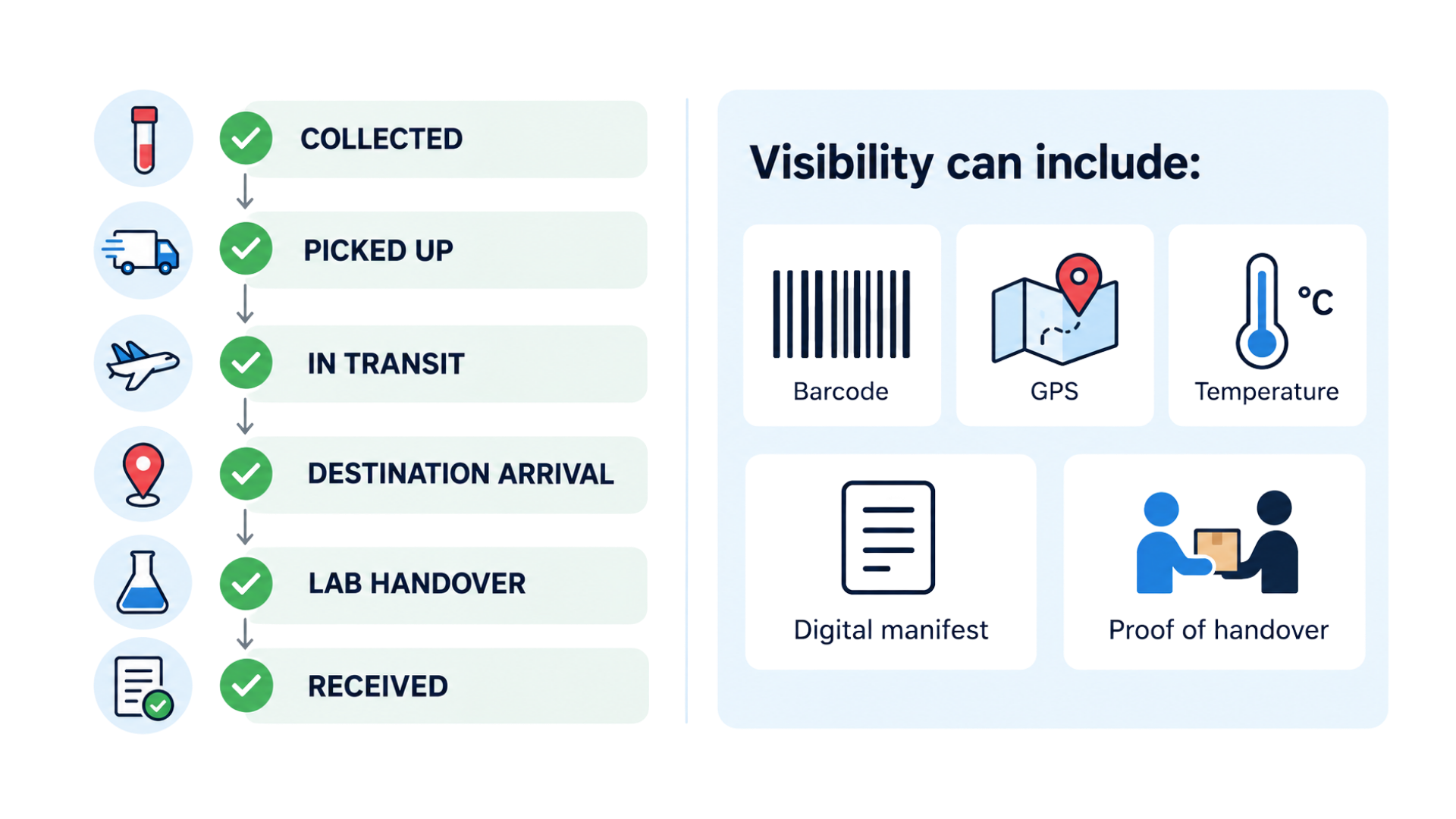
8. Laboratory Handover Is a Control Point — Not the End of the Story
A sample arriving at a laboratory does not automatically mean the logistics process has succeeded.
The receiving laboratory may need to verify whether the specimen meets its acceptance requirements. Depending on the laboratory and test, this can involve checking:
- Identification
- Request information
- Container condition
- Specimen integrity
- Collection time
- Transport conditions
- Temperature requirements
- Timing
- Quantity or volume where applicable
WHO laboratory guidance describes sample transportation and reception as controlled parts of the laboratory quality process, including checking whether samples are acceptable for the requested analysis.
This creates an important distinction:
Fast delivery ≠ successful sample delivery.
A specimen that arrives quickly but does not meet the laboratory's requirements can still create delays, rejection or recollection.
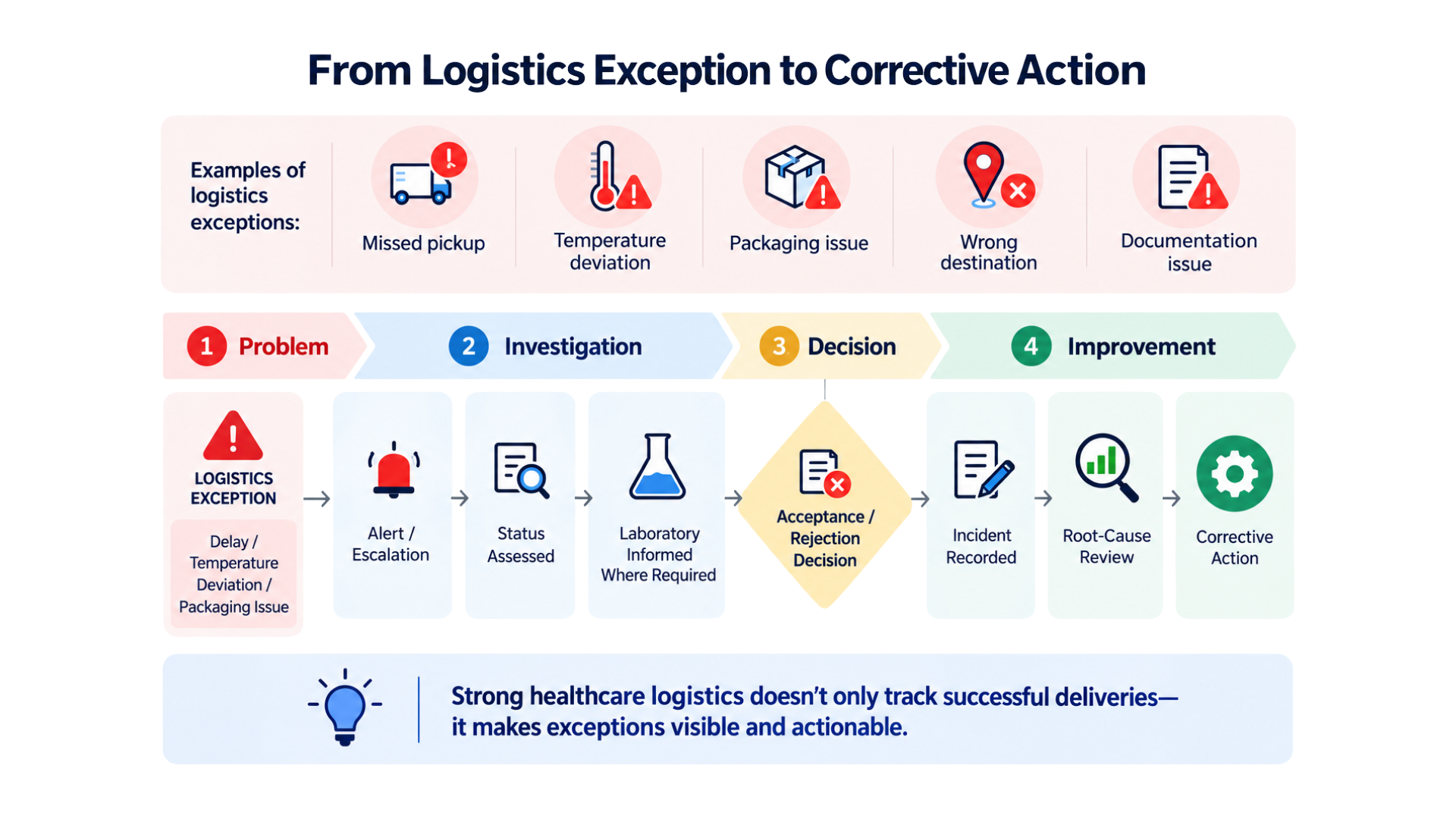
9. What Happens When Something Goes Wrong?
No logistics network operates perfectly.
The real test of a healthcare logistics system is often what happens when the plan fails. Examples include:
- Missed pickup
- Traffic delay
- Incorrect destination
- Damaged packaging
- Temperature deviation
- Documentation issue
- Vehicle breakdown
- Laboratory closure
- Missed receiving window
- Sample rejection
A mature logistics operation needs an exception-management process.
10. Why Pre-Analytical Logistics Matters
The term pre-analytical logistics describes the operational layer that sits before the laboratory actually performs the test.
Think of it as the bridge between:
Patient → Laboratory
That bridge can include:
- Home collection
- Phlebotomy
- Sample identification
- Packaging
- Pickup
- Transportation
- Cold chain
- Tracking
- Laboratory handover
This is particularly important for diagnostic networks because the laboratory cannot control every event that happens before the specimen reaches its receiving area.
C3 describes its operating model around this pre-analytical journey, covering areas including sample collection, phlebotomy, intercity logistics, cold chain and technology.
The simple idea:
The diagnostic process doesn't begin when the analyzer starts. It begins when the sample journey starts.
That is why pre-analytical logistics deserves to be managed as an operational function rather than treated as an afterthought.
What Should Diagnostic Organizations Measure?
A logistics provider shouldn't be evaluated only on whether a vehicle arrived.
For diagnostic operations, more meaningful metrics can include:
| Metric | What it tells you |
|---|---|
| Pickup adherence | Whether scheduled samples are collected on time |
| Transit time | How long samples spend in transportation |
| Laboratory receipt time | When samples reach the receiving point |
| Exception rate | How frequently transport problems occur |
| Temperature excursions | Whether required conditions were maintained |
| Sample rejection rate | Whether transport-related problems contribute to rejection |
| First-attempt pickup success | Whether planned collections happen without repeat attempts |
| Traceability | Whether the sample journey can be reconstructed |
| Handover compliance | Whether laboratory receipt is properly recorded |
These metrics turn healthcare logistics from a vague "delivery function" into something that can actually be measured and improved.
What Should You Look for in a Healthcare Logistics Partner?
If you're a diagnostic chain, hospital, laboratory network or healthcare organization evaluating a logistics provider, don't start with only one question: "What is your delivery price?"
Ask better questions.
1. Can you handle healthcare-specific logistics?
A general courier network and a healthcare logistics operation are not automatically equivalent.
2. How is sample traceability maintained?
Ask what happens from collection through laboratory receipt.
3. How are temperature-sensitive samples handled?
Understand the provider's process for packaging, transportation and temperature monitoring.
4. Can you support intercity transportation?
If samples move between cities, local delivery capability alone isn't enough.
5. What happens when a shipment is delayed?
A strong provider should have an escalation and exception-management process.
6. How is performance measured?
If there are no meaningful operational KPIs, improvement becomes difficult to prove.
7. Can the logistics operation scale with sample volume?
A system that works for 500 samples may not work the same way at 50,000.
How C3 Logistics Supports Medical Sample Transportation
C3 Logistics positions itself as a healthcare operations partner focused on the pre-analytical journey, rather than simply a conventional courier service.
Its current healthcare logistics offering includes medical courier services, blood sample transportation, cold-chain logistics, home sample collection, intercity sample logistics and healthcare supply-chain operations.
C3's website currently reports:
- 452+ cities
- 35+ air routes for sample logistics
- 20,000+ pincodes
- 24/7 operations
- 2–8°C temperature precision for its cold-chain offering
- 6,500+ field force/personnel at the group level
The larger point is the operating model.
A diagnostic organization may need multiple activities to work together:
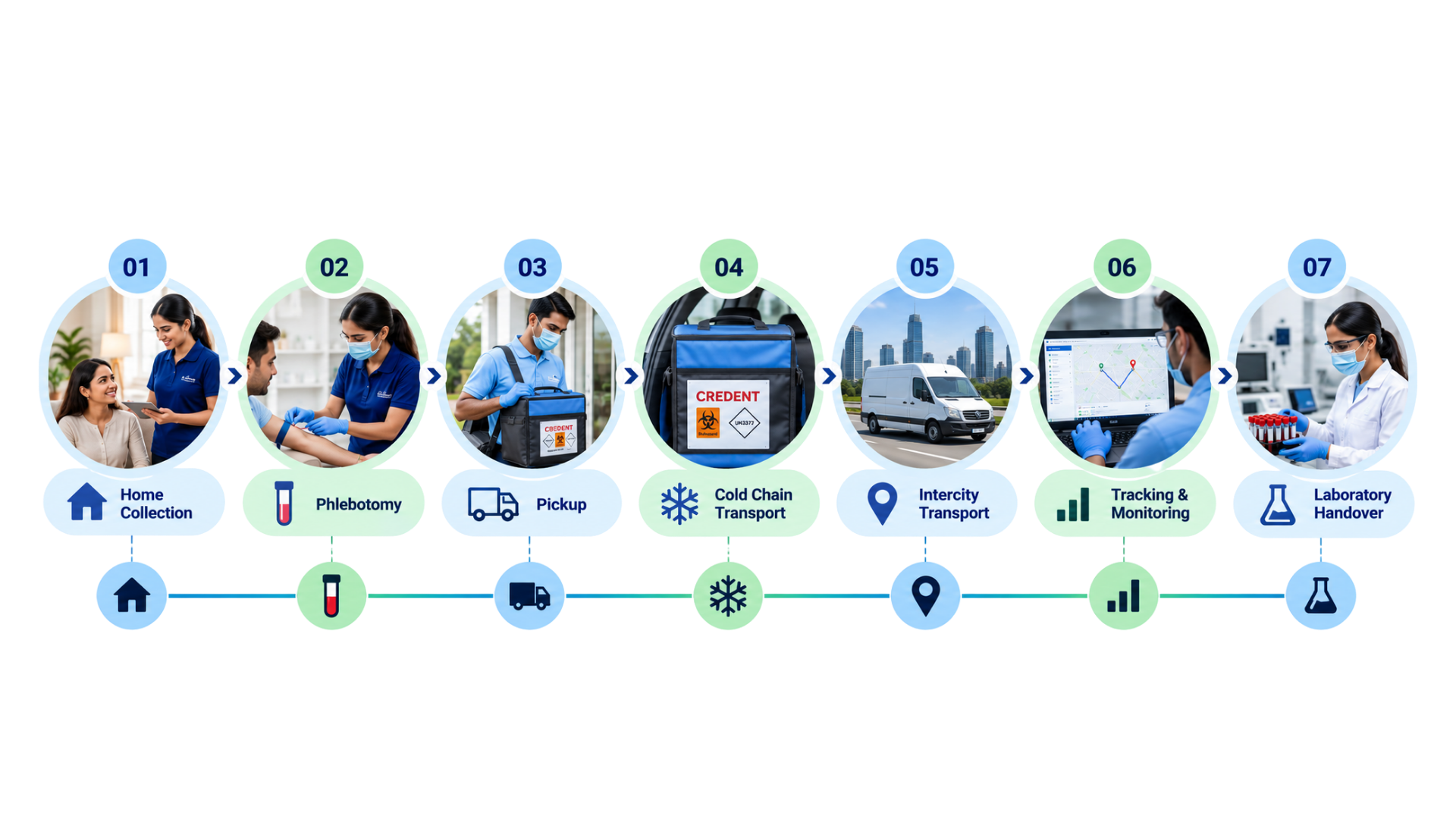
Collection → Phlebotomy → Pickup → Cold Chain → Intercity Transportation → Tracking → Laboratory Handover
When these functions are coordinated through one healthcare-focused logistics layer, the organization can gain greater visibility over the pre-analytical journey.
What Does the Future of Medical Laboratory Sample Transport Look Like?
Healthcare logistics is becoming increasingly data-driven.
As diagnostic networks expand, organizations need more than vehicles and delivery personnel.
- They need visibility.
- They need predictable processes.
- They need temperature control where required.
- They need traceability.
- And they need the ability to identify operational bottlenecks before those bottlenecks repeatedly affect laboratory workflow.
Technology can support this through:
- Digital scheduling
- Real-time tracking
- Route optimization
- Barcode-based traceability
- Temperature monitoring
- Automated alerts
- Centralized dashboards
- Digital proof of handover
But technology isn't the solution by itself.
A tracking dashboard cannot fix a poorly designed pickup process. A temperature sensor cannot compensate for inappropriate packaging. And GPS cannot solve a missed laboratory cut-off.
The technology has to sit on top of a properly designed operational process.
That's the real future of healthcare logistics:
Better processes + trained people + appropriate technology + measurable performance.
Final Takeaway
Medical laboratory sample transport is not simply about moving a tube from one address to another.
It is a controlled journey.
- Collect it correctly.
- Identify it correctly.
- Package it appropriately.
- Move it within the required conditions.
- Track the journey.
- Hand it over properly.
- Make sure the laboratory can receive it.
That is the role of healthcare logistics in the diagnostic ecosystem.
As diagnostic networks expand across cities and regions, the ability to manage this pre-analytical journey at scale becomes increasingly important.
Because ultimately, the laboratory can only test the sample that reaches it.
Healthcare logistics helps make that journey controlled, visible and operationally accountable.
Frequently Asked Questions
What is medical laboratory sample transport?
Medical laboratory sample transport is the controlled movement of diagnostic specimens from their collection location to the laboratory where they will be received and tested. Depending on the specimen and applicable requirements, transportation may involve specific packaging, documentation, temperature conditions and tracking.
How are blood samples transported to laboratories?
Blood samples are transported using specimen-appropriate containers and packaging, with handling and temperature conditions determined by the specific test and laboratory requirements.
Why is cold chain important in healthcare logistics?
Cold chain helps maintain required temperature conditions for materials that are sensitive to temperature. The required range depends on the specimen, test and applicable handling requirements.
What is pre-analytical logistics?
Pre-analytical logistics refers to operational activities before laboratory analysis, including collection, identification, packaging, storage, transportation and laboratory handover.
Why is sample tracking important?
Sample tracking provides visibility into where a specimen is within the logistics process and can help organizations identify delays, investigate exceptions and maintain traceability.
What is the difference between medical courier services and healthcare logistics?
Medical courier services primarily refer to transportation. Healthcare logistics is broader and can include collection, scheduling, packaging, cold chain, transportation, tracking, handover and operational management.
Why is laboratory sample transportation important?
Because the timing and conditions of a specimen's journey can affect whether it reaches the laboratory within the required handling conditions and whether it can be accepted for testing.